Tomahawk Missile Explained: Range, Cost, Variants and How Many the US Has
The Tomahawk missile is a long-range cruise missile fired from U.S. Navy ships and submarines and used in combat since 1991. Here is how it works, its range and cost, and how the Iran war hit U.S. stocks.
Choose Clash Report as a preferred source and see our reporting first in Top Stories.
- The Tomahawk is a subsonic, long-range cruise missile fired from U.S. Navy ships and submarines, with a range of about 1,600 km for current versions.
- Each new Block V missile costs about $3.64 million, according to the Navy’s fiscal 2026 figures.
- The 2026 war with Iran saw the heaviest Tomahawk use ever, with at least 1,000 fired, according to the IISS.
Since the 1991 Gulf War, the Tomahawk has been Washington’s first choice for opening strikes. It lets the Navy hit targets deep inside hostile territory without risking pilots.
This guide explains how the Tomahawk works, its variants and range, what it costs, how many the U.S. may have and who else uses it.
What Is the Tomahawk Missile?
The Tomahawk Land Attack Missile (TLAM) is an all-weather, subsonic cruise missile built by Raytheon. It flies at very low altitude and follows an evasive route to reach heavily defended targets.
- Maker: Raytheon, Tucson, Arizona
- Designation: BGM-109, with RGM/UGM-109 for ship and submarine versions
- Range: about 900 nautical miles (1,600 km) for Block IV and V, per the Navy
- Length: 20.3 feet (6.2 m) with booster
- Weight: 3,330 lb (about 1,510 kg) with rocket motor
- Warhead: a 1,000-pound-class conventional warhead
- Engine: Williams International turbofan, with a solid-fuel booster for launch
How the Tomahawk Works
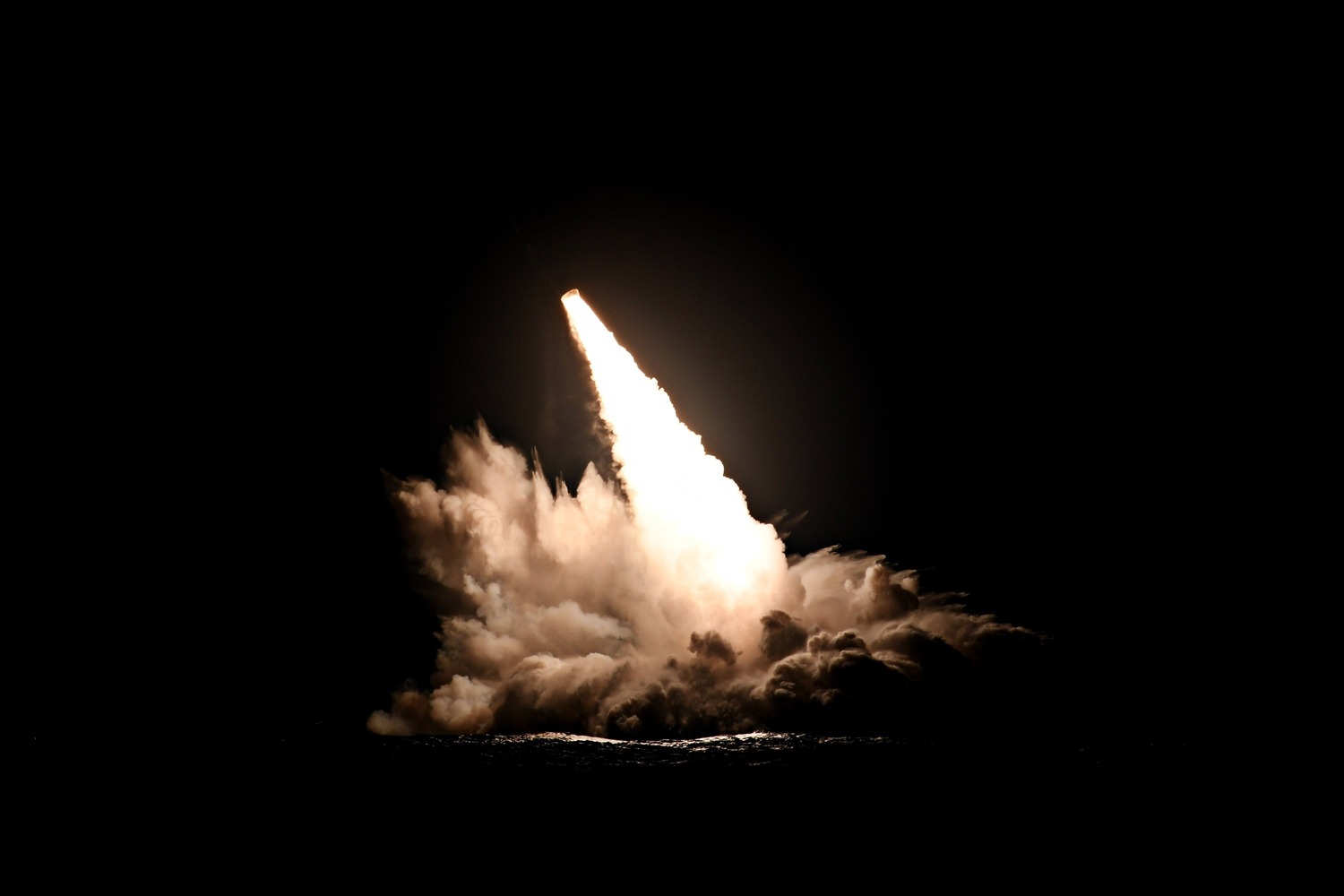
A solid rocket booster pushes the missile out of a ship’s vertical launch cell or a submarine. Wings unfold and a small jet engine takes over for the long flight.
The missile uses GPS, inertial navigation and terrain matching to steer. A camera-based system called DSMAC compares the ground below with stored images near the target.
Block IV and later missiles can be retargeted in flight by satellite link. They can loiter over an area and send back images to help commanders judge damage, the Navy says.
Tomahawk Variants: From TLAM-N to Block V
| Version | Role | Status |
|---|---|---|
| TLAM-N | Nuclear land attack with W80 warhead | Retired after 2010 review |
| TASM | Early anti-ship version | Removed in 1994 |
| Block II/III TLAM-C, D | Conventional land attack | Retired |
| Block IV TLAM-E | In-flight retargeting, loiter | Entered fleet in 2004 |
| Block V | Upgraded navigation and communications | Fleet introduction in 2021 |
| Block Va (Maritime Strike Tomahawk) | Moving ships at sea | Being added |
| Block Vb | New JMEWS multi-effects warhead | Planned |
Existing Block IV missiles are being recertified and upgraded to Block V, which gives each one about 15 more years of service life, according to the Navy.
Also read: Features of Tomahawk Missiles the U.S. Refused to Supply Ukraine
How Much Does a Tomahawk Cost?
The Navy lists a Block V unit cost of about $3.64 million in fiscal 2026 dollars. Foreign sales cost more per missile because they bundle launchers, training and support.
Japan signed a $1.7 billion deal in January 2024 for 400 Tomahawks, according to Naval News. Production is limited: CSIS says the Navy was set to receive 110 new missiles in fiscal 2026.
How Many Tomahawks Does the US Have?
The Pentagon does not publish its inventory. CSIS estimated U.S. stocks in the low 3,000s before the 2026 war with Iran.
In the first four weeks of that war, U.S. ships and submarines fired more than 850 Tomahawks, The Washington Post reported. CSIS called it the most fired in a single campaign.
The IISS later counted at least 1,000 fired, roughly a third of the pre-war stock. It said rebuilding Tomahawk inventories to pre-war levels could take three years or more.
Clash Report has reported on how the war drained U.S. long-range missile stockpiles.
Combat History and Users
Tomahawks were first used in combat in the 1991 Gulf War. NAVAIR put the combat total at more than 2,300 in a figure published before the Iran war added hundreds more.
Other notable uses include the 2003 invasion of Iraq, Libya in 2011 and a strike on a Syrian air base in 2017. The missiles can be launched from more than 140 U.S. ships and submarines, CSIS says.
- United Kingdom: the first foreign buyer, fires them from Royal Navy submarines
- Australia: approved in 2023 for up to 220 missiles
- Japan: 400 missiles under the 2024 deal
- Netherlands: approved in 2025
- Germany: is seeking Tomahawks and the Army’s Typhon launcher, as Clash Report reported
Why It Matters
The Tomahawk is one of the few weapons that lets the U.S. strike far inland from the sea at short notice. It is also central to plans for any war in the Western Pacific.
Heavy use against Iran has turned the missile into a symbol of a wider problem. Washington can fire munitions far faster than its factories can replace them.
Frequently Asked Questions
What is the range of a Tomahawk missile? Current Block IV and V Tomahawks fly about 1,600 km, or 1,000 statute miles.
Is the Tomahawk nuclear? Today’s Tomahawks carry conventional warheads, since the nuclear TLAM-N was retired.
What does TLAM stand for? TLAM means Tomahawk Land Attack Missile.
How fast is a Tomahawk? It flies at high subsonic speed, slower than sound, and stays low to avoid radar.
Kamer Kurunç
Kamer Kurunç is the Editor-in-Chief of Clash Report and has led the outlet for four years. Kamer sets the site's editorial direction and writes and edits coverage across the World and Defense sections, with a focus on the Russia-Ukraine war, NATO, Israel and Iran, Türkiye, North Korea and nuclear weapons. Kamer has written more than 1,100 articles for Clash Report.
Choose Clash Report as a preferred source and see our reporting first in Top Stories.