How Nuclear Bombs Work: Fission vs Fusion, Atomic vs Hydrogen Bombs and Yields
A nuclear bomb gets its power from splitting or fusing atoms. Here is how fission and fusion weapons work, the difference between atomic and hydrogen bombs, and how their yields compare.
Choose Clash Report as a preferred source and see our reporting first in Top Stories.
- Every nuclear weapon starts with fission, the splitting of heavy uranium or plutonium atoms in a chain reaction.
- Hydrogen bombs use a fission blast to trigger fusion, which lets them reach yields in the megatons.
- Yields range from about 8 kilotons for the smallest U.S. submarine warhead to roughly 50 megatons for the Soviet Tsar Bomba.
A nuclear bomb releases energy stored inside the nucleus of the atom. A single modern warhead can release more explosive energy than all the weapons used in World War II, according to the Union of Concerned Scientists.
This guide explains how nuclear bombs work, the difference between atomic and hydrogen bombs and how yields compare. For the list of nuclear-armed states, see our guide to who has nuclear weapons.
What Is a Nuclear Bomb?
A nuclear bomb is a weapon that gets its explosive force from nuclear reactions rather than chemicals. Its power is measured in kilotons or megatons, meaning thousands or millions of tons of TNT.
There are two basic types: atomic, or fission, bombs split heavy atoms. Thermonuclear bombs, often called hydrogen bombs, add a second stage that fuses light atoms.
How Fission Works: The Atomic Bomb
In fission, a neutron hits the nucleus of a heavy atom such as uranium-235 or plutonium-239. The nucleus splits, releases energy and frees more neutrons.
Those neutrons can split nearby atoms, creating a chain reaction. The bomb needs a critical mass, the minimum amount of material that can sustain that reaction.
“Little Boy,” dropped on Hiroshima, fired one piece of uranium-235 into another to reach critical mass. This is known as a gun-type design.
Modern weapons use implosion instead. Explosives around a hollow sphere of plutonium or uranium, called a pit, squeeze it until it goes critical, the UCS explains.
Many designs are “boosted” with deuterium and tritium gas inside the pit. A small amount of fusion releases extra neutrons, which makes the fission far more efficient.
How Fusion Works: The Hydrogen Bomb
Fusion is the opposite of fission. Under extreme heat and pressure, light nuclei such as hydrogen isotopes join together and release energy, the same process that powers the sun.
A thermonuclear weapon has two stages. The fission primary explodes first, and its X-rays compress and heat a secondary stage that contains fusion fuel.
Neutrons from the fusion then split atoms in a uranium layer around the secondary. That extra fission often supplies more than half of the weapon’s total yield, according to the UCS.
The United States tested the first full-scale hydrogen bomb, Ivy Mike, on Nov. 1, 1952. It released 10.4 megatons, about 1,000 times the Hiroshima bomb, Smithsonian magazine notes.
Atomic Bomb vs Hydrogen Bomb
| Atomic (fission) bomb | Hydrogen (thermonuclear) bomb | |
|---|---|---|
| Main reaction | Splitting heavy atoms | Fission trigger plus fusion |
| Fuel | Uranium-235 or plutonium-239 | Fission primary plus hydrogen isotopes and uranium |
| Typical yield | Kilotons | Hundreds of kilotons to megatons |
| First test | July 1945 (Trinity) | November 1952 (Ivy Mike) |
| Used in war | Hiroshima and Nagasaki, 1945 | Never |
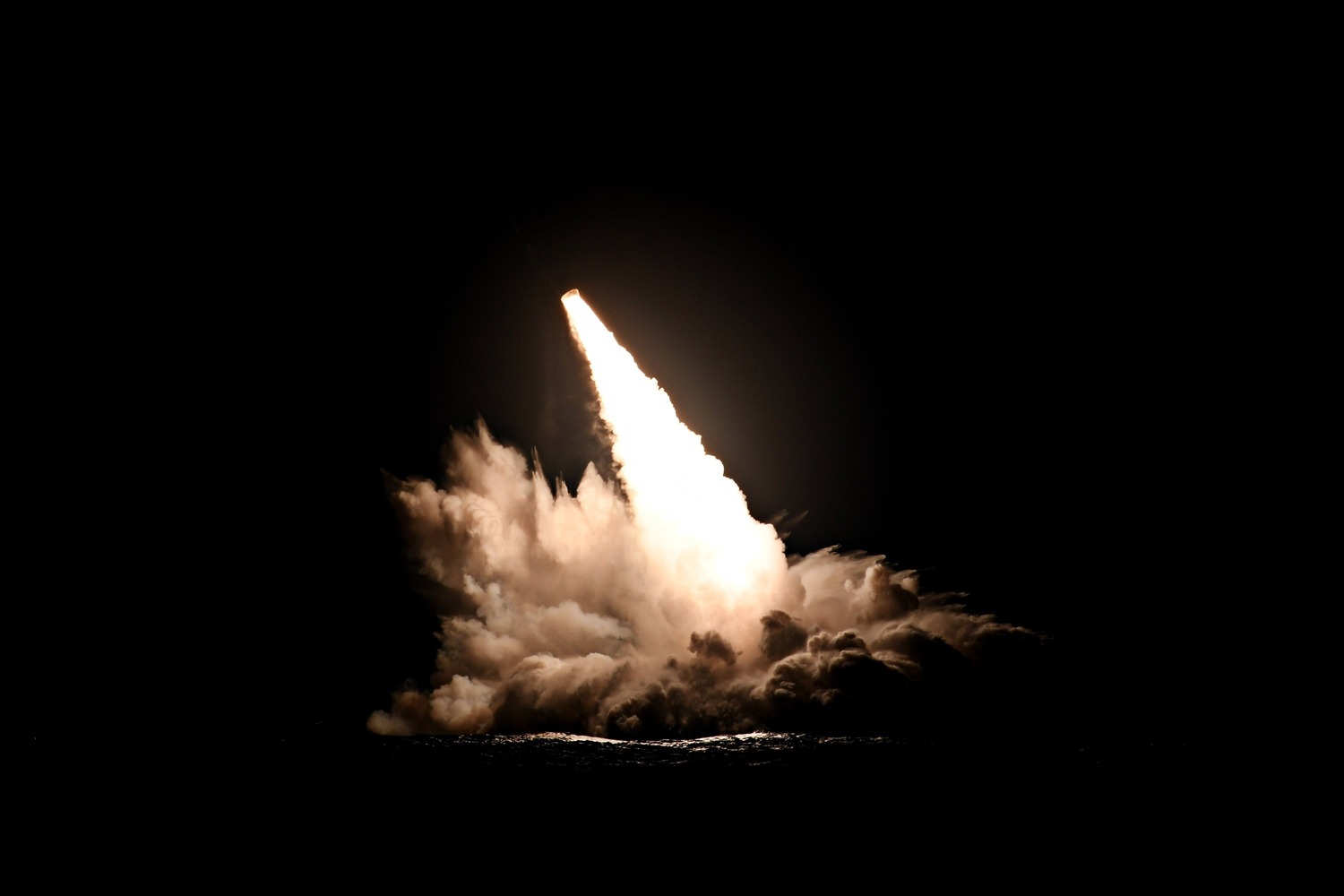
Modern thermonuclear warheads are compact. A single U.S. Trident submarine missile can carry up to eight W88 warheads, according to the Federation of American Scientists.
Nuclear Bomb Yields Compared
| Weapon or test | Year | Estimated yield |
|---|---|---|
| W76-2 submarine warhead | Current | About 8 kilotons |
| Little Boy (Hiroshima) | 1945 | 15 kilotons |
| Fat Man (Nagasaki) | 1945 | 21 kilotons |
| W76-1 submarine warhead | Current | 90 kilotons |
| W88 submarine warhead | Current | 455 kilotons |
| Ivy Mike, first U.S. H-bomb test | 1952 | 10.4 megatons |
| Castle Bravo, largest U.S. test | 1954 | 15 megatons |
| Tsar Bomba, largest test ever | 1961 | About 50 megatons |
Castle Bravo’s designers expected five to six megatons. The shock of 15 megatons came from a miscalculation and caused the worst U.S. radioactive contamination accident, Brookings notes.
Also read: Tsar Bomba: The Largest Nuclear Bomb Ever Detonated
Nuclear Fuel: Uranium and Plutonium
Less than 1 percent of natural uranium is uranium-235. Making bomb material requires enrichment, usually in centrifuges, which is costly and hard to hide.
Plutonium is made in reactors and separated through reprocessing. Access to these materials, not the physics, is the main barrier to building a bomb.
US Nuclear Weapons Today
The United States had a military stockpile of about 3,700 warheads in early 2025, according to the Federation of American Scientists. Its submarines carry the W76-1, the low-yield W76-2 and the W88.
The National Nuclear Security Administration finished upgrading the B61-12 bomb and the W88 in 2025 and produced the first B61-13. Clash Report has explained the earlier B61-11 bunker buster.
In November 2026, a Senate spending draft listed a new B94 nuclear bomb designation, the first new bomb number in decades.
Why It Matters
Arms control is weakening, and New START, the last treaty limiting U.S. and Russian strategic arsenals, expired in February 2026. Knowing how these weapons work helps make sense of debates over new warheads and testing.
The physics has not changed since the 1950s. What has changed is the number of states building or expanding arsenals.
Frequently Asked Questions
What is the difference between an atomic bomb and a hydrogen bomb? An atomic bomb uses fission alone, while a hydrogen bomb uses a fission blast to drive fusion.
How powerful is a nuke bomb? Yields range from a few kilotons to megatons, and the Hiroshima bomb was about 15 kilotons.
What is the most powerful nuclear bomb ever tested? The Soviet Tsar Bomba, at about 50 megatons in 1961.
How many nuclear weapons does the US have? About 5,042 warheads in total in January 2026, according to SIPRI.
Kamer Kurunç
Kamer Kurunç is the Editor-in-Chief of Clash Report and has led the outlet for four years. Kamer sets the site's editorial direction and writes and edits coverage across the World and Defense sections, with a focus on the Russia-Ukraine war, NATO, Israel and Iran, Türkiye, North Korea and nuclear weapons. Kamer has written more than 1,100 articles for Clash Report.
Choose Clash Report as a preferred source and see our reporting first in Top Stories.