Who Is Alberto Núñez Feijóo? Spain’s Conservative PP Leader Explained
Alberto Núñez Feijóo, the People’s Party leader whose party led the polls in Spain’s Nov. 29 snap election, is a former health manager who won four absolute majorities in Galicia. Here is his path, his politics and his controversies.
Choose Clash Report as a preferred source and see our reporting first in Top Stories.
- Feijóo, 65, governed Galicia for 13 years after winning four straight absolute majorities between 2009 and 2020.
- He took over a divided People’s Party in April 2022, won the most seats in 2023 and still failed to become prime minister.
- On Nov. 29, 2026, election-night projections put his party first again, with Vox likely needed for a majority.
For most of his career, Feijóo was a manager rather than a campaigner. He ran hospitals, a national health network and the state postal company before he ever led a party.
That record shaped his pitch to Spanish voters. He presents himself as a cautious administrator, a contrast he draws often with Prime Minister Pedro Sánchez.
Early Life in Galicia
Feijóo was born on Sept. 10, 1961, in the province of Ourense, in Spain’s northwestern region of Galicia. He grew up in Os Peares, a small village where the Miño and Sil rivers meet.
He finished secondary school as a boarder at a Marist Brothers school in León. He then studied law at the University of Santiago de Compostela.
In 1985 he passed the exam to join Galicia’s senior civil service. He remains a career civil servant on leave.
From Health Manager to Madrid
His rise came through health administration. In 1991 he joined Galicia’s health department under José Manuel Romay Beccaría, a veteran conservative who became his political mentor.
From 1992 to 1996 he was vice president and secretary general of the Galician Health Service, the region’s public health system.
When José María Aznar’s PP won power in 1996, Romay became health minister and took Feijóo to Madrid. There he ran Insalud, the national health institute, until 2000.
He then led Correos, the state postal service, from 2000 to January 2003. During his tenure it was turned into a state-owned public limited company.
Four Majorities in Galicia
Feijóo returned home in 2003 to join the regional government of Manuel Fraga, the PP’s founder. He became public works minister and, in 2004, first vice president.
The PP lost Galicia in 2005 to a Socialist-nationalist coalition. A year later Feijóo won the race to succeed Fraga as regional party leader.
In March 2009 he won back the Xunta, Galicia’s government, with an absolute majority of 38 of 75 seats. He repeated the feat in 2012, 2016 and 2020.
Only Fraga had won four in a row in Galicia before him. The run made Feijóo the PP’s most successful regional leader.
He declined to run for the national leadership in 2018, after Mariano Rajoy’s fall. He said he would keep his promise to the Galician voters.
Taking Over the PP
His moment came in early 2022. A bitter feud between then-leader Pablo Casado and Madrid regional president Isabel Díaz Ayuso split the party and forced Casado out.
Feijóo was the only candidate at an extraordinary congress in Seville on April 2, 2022, and won more than 98% of delegates’ votes. He left the Galician presidency in May.
Without a seat in Congress, he became a senator appointed by the Galician parliament. That gave him a platform to face Sánchez in the upper house.
The 2023 Election and Failed Investiture
Sánchez called a snap election for July 23, 2023. Most polls predicted a PP win and a right-wing majority with Vox.
The PP did come first, with 137 seats and 33.1% of the vote. But the PP, Vox and two small allies reached only 172 seats, four short of a majority.
Feijóo accepted the king’s nomination anyway. He lost two investiture votes in late September 2023, the second by 172 votes to 177.
Sánchez then secured a new term in November, backed by left-wing, Catalan and Basque parties. The deal included an amnesty for Catalan separatists.
Also read: Feijóo Refuses to Call Gaza a Genocide as Sánchez Presses Him in Debate
Vox and the Right
Feijóo’s relationship with Vox is the central question of his career. The far-right party, led by Santiago Abascal, was founded in 2013 by former PP members.
After regional elections in 2023, the PP formed coalitions with Vox in several regions. Vox walked out of them in July 2024 in a dispute over housing migrant minors.
Feijóo says he would prefer to govern alone. Before the 2026 vote, he told POLITICO that “the ballot box will decide the deals.”
Catalonia and the Amnesty
Feijóo fiercely opposed the amnesty law for those involved in Catalonia’s 2017 independence bid. He has described it as the price Sánchez paid to stay in power.
The PP organized mass street protests against the law, which parliament passed in May 2024. In 2023 he refused to negotiate with Carles Puigdemont’s Junts on its amnesty terms.
Economy and Immigration
On the economy, Feijóo promises tax cuts and an audit of the public accounts in his first 100 days. He also pledges to repeal several of Sánchez’s laws.
On migration, his 2026 program marks a clear hardening. It came after a mass crossing into the Spanish enclave of Ceuta from Morocco in July 2026.
The PP proposes to ban mass regularizations by law and to identify irregular arrivals within seven days. It also plans annual work quotas and a points-based visa.
Foreigners convicted of sexual or violent crimes, or of repeated offenses, would be expelled as a general rule.
Ukraine, NATO and Gaza
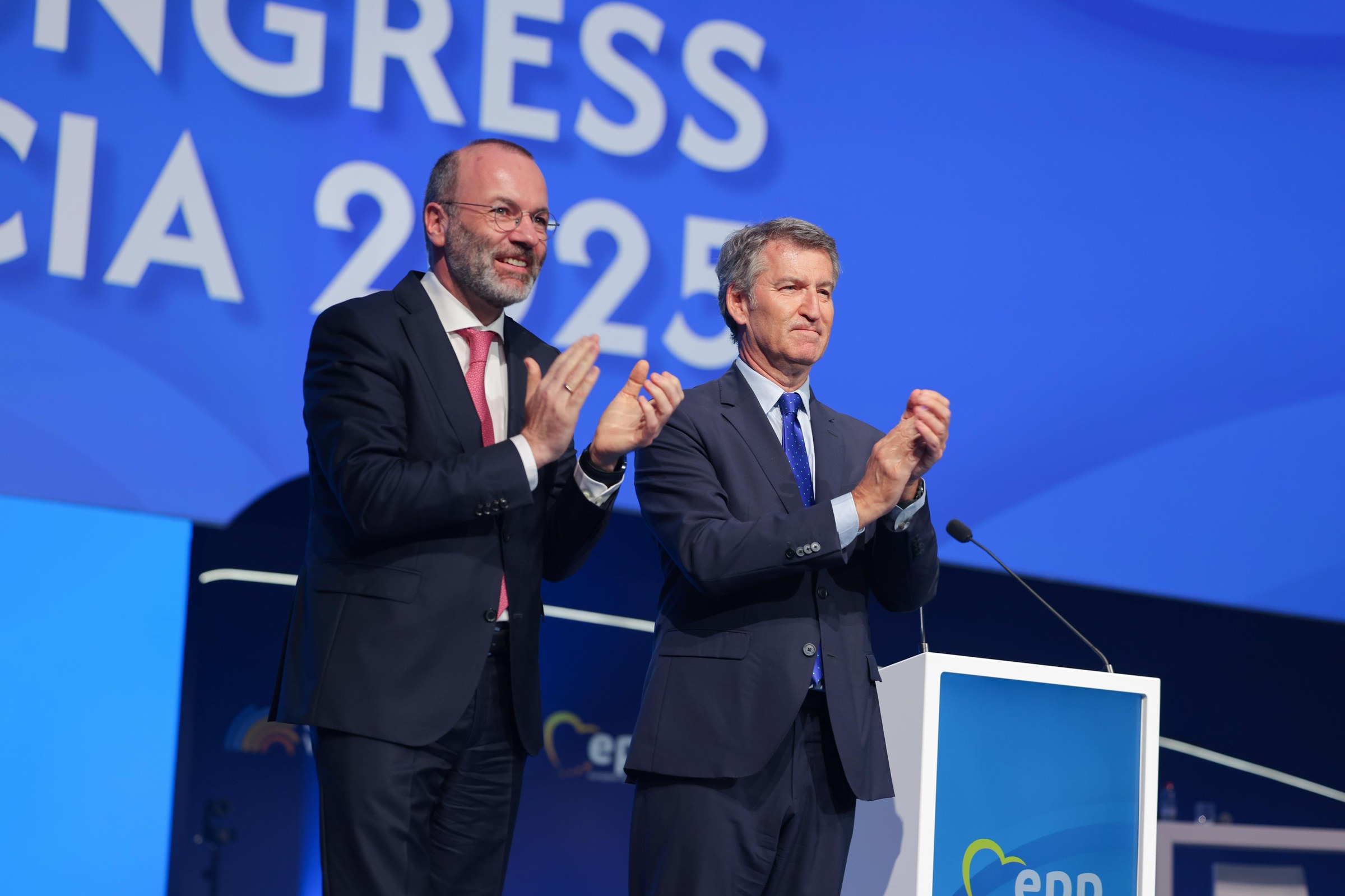
Feijóo is a member of the European People’s Party, the EU’s largest political family. He backs European support for Ukraine against Russia’s invasion.
On defense, he says Spain “will be a reliable partner again” in NATO. He has not committed to a spending figure before an audit of the public finances.
On Gaza, he calls Israel’s war “a massacre” but refuses to use the word genocide. He said in 2023 that Hamas “must be destroyed.”
He supports a two-state solution in principle. But he opposed Sánchez’s recognition of a Palestinian state in May 2024, saying it would “empower” Hamas.
The Marcial Dorado Photos
The most persistent controversy of his career dates to the 1990s. In 2013, El País published photos of Feijóo in 1995 aboard a boat owned by Marcial Dorado.
Dorado was then known as a tobacco smuggler. He was later arrested in 2003 in a cocaine trafficking case and sentenced to prison.
Feijóo confirmed the photos were genuine. He said the relationship was personal, denied any financial ties and said he did not know about Dorado’s illegal business.
He called them “old photos” and refused to resign. Opponents have raised the episode in campaigns ever since, and fabricated images have also circulated online.
The 2026 Snap Election
Sánchez called the Nov. 29, 2026, election after parliament rejected his housing decrees. Corruption probes, the Ceuta crisis and two deadly train crashes also weighed on his government.
The PP led the polls throughout the campaign. A Sigma Dos projection for RTVE, released when polls closed, gave it 131 to 136 seats.
With Vox, the right would reach 175 to 184 seats, around the 176 needed for a majority. Three other projections put the bloc above that line.
The official count began after polls closed in the Canary Islands. By 9:13 p.m. Madrid time (11:13 p.m. in Türkiye), 8.6% of votes had been counted.
At that point the PP had 126 seats, the Socialists 114 and Vox 47, according to the Interior Ministry. The figures are provisional and will change.
Also read: Spain Poll Puts Feijóo’s PP First as Right-Wing Bloc Nears Majority
Why It Matters
If the projections hold, Feijóo would end eight years of Socialist rule in Spain. The eurozone’s fourth-largest economy would move to the right.
The bigger question is Vox. A PP government that depends on it could give the far right national influence, possibly cabinet seats, for the first time since Franco.
Abroad, a Feijóo government would likely be friendlier to Washington and less confrontational with Israel. It could also end Spain’s role as NATO’s main holdout on spending.
His career suggests caution rather than rupture. But his first test would be building a majority, something he failed to do in 2023.
Frequently Asked Questions
How old is Alberto Núñez Feijóo? He was born on Sept. 10, 1961, and is 65.
Where is Feijóo from? He is from the province of Ourense in Galicia and grew up in the village of Os Peares.
What party does Feijóo lead? He has led the conservative People’s Party (PP) since April 2022.
Was Feijóo president of Galicia? Yes. He led the Xunta de Galicia from 2009 to 2022 after four absolute majorities.
Why did Feijóo not become prime minister in 2023? His party came first, but he lost the investiture votes with 172 votes, four short of a majority.
Will Feijóo govern with Vox? He says he prefers to govern alone. Without a PP majority, he would likely need Vox’s votes.
Kamer Kurunç
Kamer Kurunç is the Editor-in-Chief of Clash Report and has led the outlet for four years. Kamer sets the site's editorial direction and writes and edits coverage across the World and Defense sections, with a focus on the Russia-Ukraine war, NATO, Israel and Iran, Türkiye, North Korea and nuclear weapons. Kamer has written more than 1,100 articles for Clash Report.
Choose Clash Report as a preferred source and see our reporting first in Top Stories.