What Is KAAN? Türkiye’s Fifth-Generation Fighter Jet Explained
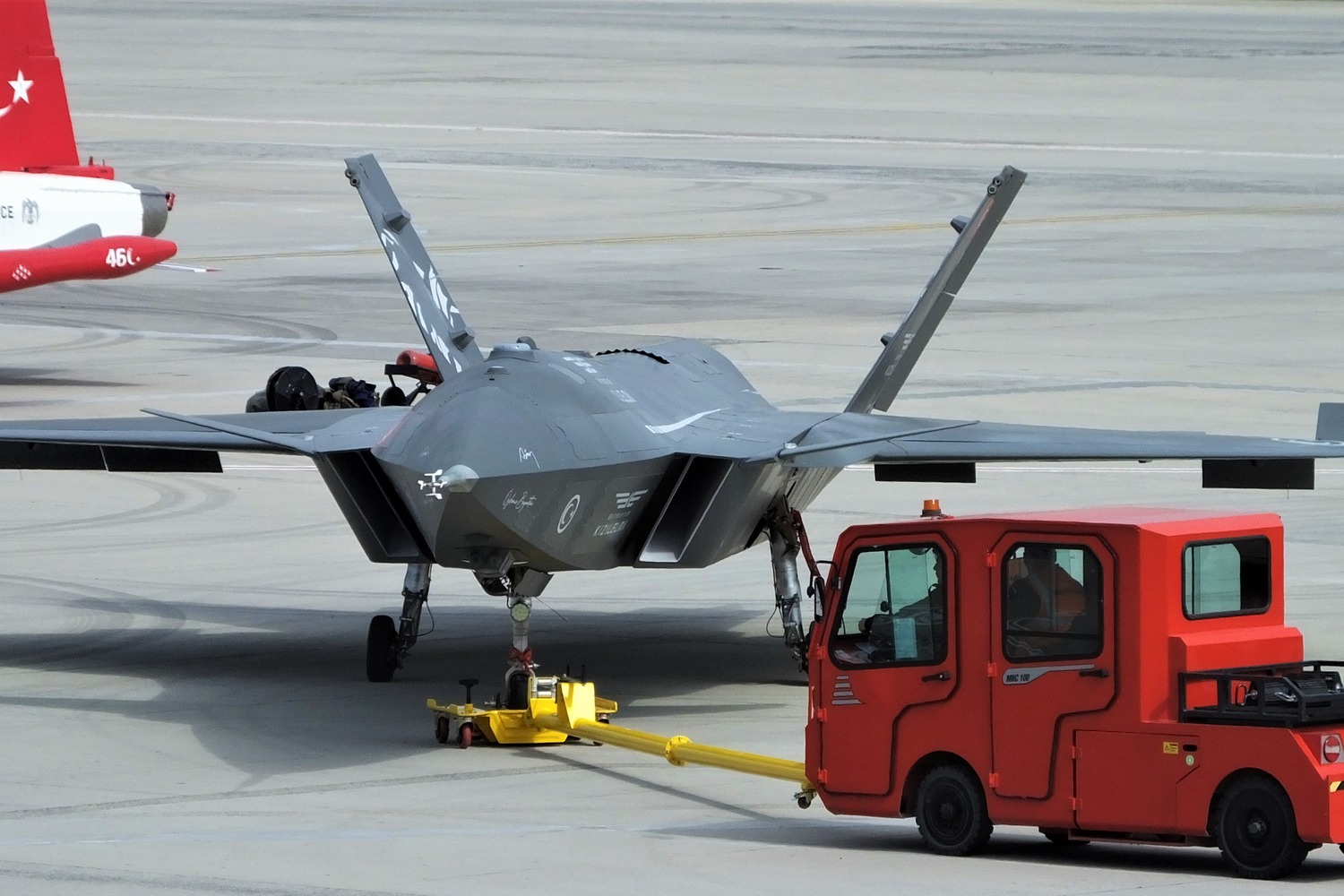
KAAN is the twin-engine stealth fighter Türkiye is building to replace its F-16s. Here is how it works, where testing stands, which engine it uses and who has agreed to buy it.
Choose Clash Report as a preferred source and see our reporting first in Top Stories.
- KAAN is a twin-engine stealth fighter designed by Turkish Aerospace (TUSAŞ) to replace the F-16s that form the backbone of the Turkish Air Force.
- Only one prototype has flown so far, twice in 2024. A more advanced second prototype, P1, is in ground tests and is meant to fly before the end of 2026.
- Defense Minister Yaşar Güler says 20 jets should reach the Air Force by the end of 2030 and 100 by the end of 2035.
Türkiye has flown American fighters for more than half a century, from the F-100 to the F-16. KAAN is its attempt to break that pattern with a combat jet it designs and largely builds at home.
The program became far more urgent after the United States removed Türkiye from the F-35 project in 2019. It is now the most expensive and most closely watched effort in the Turkish defense industry.
This guide explains what KAAN is, where testing stands, which engine it uses, what it will carry and who has agreed to buy it.
What Is the KAAN Fighter Jet?
KAAN is Türkiye’s National Combat Aircraft, known in Turkish as MMU (Milli Muharip Uçak). For years it was called TF-X, short for Turkish Fighter.
TUSAŞ describes it as a fifth-generation fighter. That label refers to features such as a low radar signature, weapons carried inside the body, sensor fusion and the ability to work with other aircraft and drones.
- Maker: Turkish Aerospace Industries (TUSAŞ, also known as TAI), the state-backed prime contractor
- Crew: One pilot
- Role: Multirole, for both air-to-air combat and strikes on ground targets
- Main customer: The Turkish Air Force, which plans to phase out its F-16s gradually from the 2030s
- Name: President Recep Tayyip Erdoğan announced the name KAAN on May 1, 2023. It is an old Turkic title for a ruler.
KAAN Specs
TUSAŞ publishes the following figures for the current design. They are design data, and the jet has not yet been tested at these limits.
| Specification | KAAN (TUSAŞ data) |
|---|---|
| Length | 20.3 m (66 ft) |
| Wingspan | 13.4 m (44 ft) |
| Height | 5 m (16 ft) |
| Wing area | 71.6 m² (771 sq ft) |
| Maximum takeoff weight | 34,750 kg (76,500 lb) |
| Thrust | 2 x 13,150 kgf (2 x 29,000 lb) |
| Maximum speed | Mach 1.8 at 40,000 ft |
| Service ceiling | 55,000 ft (16,764 m) |
| G limits | +9 / -3.5 G |
| Engines | Two General Electric F110 turbofans on prototypes and early blocks |
The design has shrunk slightly since the first prototype. P0 was about 21 m long with a 14 m wingspan and a height of 6 m, TURDEF reported, before TUSAŞ published the smaller figures for later aircraft.
How KAAN Was Developed
Türkiye’s Defense Industry Executive Committee approved a national fighter program on Dec. 15, 2010. Early talks with Sweden’s Saab were dropped, and Ankara decided to lead the design itself.
The design and development contract between the defense procurement agency and TUSAŞ was signed on Aug. 5, 2016.
- January 2017: BAE Systems and TUSAŞ signed an agreement, reported to be worth about £100 million, for the British company to provide engineering support during a visit to Türkiye by Prime Minister Theresa May.
- March 2023: The first prototype, P0, began taxi trials at TUSAŞ’s base in Ankara.
- May 1, 2023: Erdoğan revealed the name KAAN at a ceremony at TUSAŞ.
- Feb. 21, 2024: P0 made KAAN’s first flight, staying airborne for 13 minutes and reaching 8,000 feet and 230 knots.
- May 6, 2024: P0 flew a second time, for 14 minutes at 10,000 feet.
- February 2026: TUSAŞ showed the P1 and P2 prototypes and a ground-test airframe to the press.
- July 31, 2026: P1 began taxi tests, according to Türkiye’s Defense Industry Agency (SSB).
- Oct. 2, 2026: TUSAŞ General Manager Mehmet Demiroğlu said P1 had completed its system checks and low-speed taxi runs, with high-speed taxi tests next.
As of late November 2026, neither TUSAŞ nor the SSB had announced a first flight by P1. Demiroğlu has said the goal is to fly it before the end of the year if there are no setbacks, followed soon by P2.
Unlike P0, which was built to test basic flying qualities, P1 and P2 are closer to the production design and carry mission systems. TUSAŞ plans six development prototypes in total.
Also read: What Is Bayraktar KIZILELMA? Türkiye’s Unmanned Fighter Jet Explained
When Will KAAN Enter Service?
TUSAŞ is targeting the first deliveries to the Turkish Air Force from late 2028. Some analysts have warned the date could slip toward 2030, Middle East Eye reported.
Güler gave the clearest schedule yet on Nov. 18, 2026, while presenting his ministry’s 2027 budget to parliament.
- End of 2030: 20 aircraft expected to be delivered to the Air Force
- End of 2035: The fleet expected to reach 100 aircraft
- Block 10 and Block 20: Early production versions powered by U.S.-made F110 engines
- Block 30 onward: Versions meant to switch to Türkiye’s own TF35000 engine, according to the Defense Ministry
A first delivery does not mean the jet is combat-ready. Early blocks are expected to have limited capability, with weapons and sensors added in later versions.
Which Engine Does KAAN Use?
The engine is KAAN’s biggest foreign dependency. Prototypes and early jets use two General Electric F110-GE-129 turbofans, the same engine family that powers Türkiye’s F-16s.
The Defense Ministry said in December 2025 that all engines under TUSAŞ’s first GE contract had arrived by September 2025. A second batch of 80 engines was still under discussion with Washington.
- June 24, 2026: The U.S. State Department notified Congress of a proposed F110 engine sale to Türkiye worth about $700 million, Reuters reported.
- July 9, 2026: The congressional review period expired without a vote on a resolution to block the sale, moving the deal to commercial talks.
- Earlier: Foreign Minister Hakan Fidan had complained that KAAN’s engines were “waiting in the U.S. Congress.”
Türkiye’s long-term answer is the TF35000, developed by TEI and TRMotor. It is designed for about 35,000 pounds of thrust with afterburner, which would let KAAN cruise faster than sound without afterburner, a feature known as supercruise.
TUSAŞ has said it aims to finish developing the engine by 2032, Breaking Defense reported. Türkiye has also brought its aero-engine work under one roof to speed up the effort.
Avionics and Weapons
ASELSAN is the prime contractor for KAAN’s avionics. It showed the main sensors at the Paris Air Show in June 2025, TURDEF reported.
- MURAD 600-A: An active electronically scanned array (AESA) radar, a larger relative of the MURAD 100-A flying on Turkish F-16s and drones
- KARAT 100: An infrared search and track sensor that detects aircraft by their heat without emitting radar signals
- TOYGUN 100: An electro-optical targeting system for finding and designating ground targets
- Self-protection: IRIS 300 missile warning, LIAS 300 laser warning and the YILDIRIM 300 directional infrared countermeasure
- TULGAR: A helmet-mounted display for the pilot
KAAN is designed to carry weapons in internal bays to keep its radar signature low. Planned loads include air-to-air missiles, the SOM-J cruise missile, TOLUN glide bombs and guided bombs, with external pylons for missions where stealth matters less.
Most of these weapons are Turkish. Türkiye is developing its own air-to-air missiles, including GÖKDOĞAN and BOZDOĞAN, to reduce reliance on U.S. weapons.
TUSAŞ also plans for KAAN to control drones such as ANKA-3 as autonomous wingmen.
Who Is Buying KAAN?
Indonesia is KAAN’s first export customer. The two governments signed an agreement in Jakarta on June 11, 2025, followed by an implementation contract for 48 jets at the IDEF exhibition in Istanbul on July 26, 2025.
TUSAŞ called it the largest defense agreement in the history of the Turkish Republic. Delivery was planned within 120 months, and the contract value was not officially disclosed.
Turkish media put the deal at about $10 billion, a figure that has not been confirmed by either government. On April 2, 2026, Indonesia’s Defense Ministry said an initial contract for a limited number of jets was still being activated through a foreign loan, ANTARA reported.
- Saudi Arabia: Erdoğan said in February 2026 that a Saudi joint investment in KAAN “could be realised at any moment.” No deal has been announced.
- Azerbaijan: Signed a protocol in July 2023 on cooperation in the program.
- Pakistan: Has been described by Turkish officials as a potential partner. Reports say Pakistani engineers have worked on the program.
- Egypt: Reportedly agreed in 2025 to join the program, including co-production, though details have not been published.
KAAN vs F-35, KF-21 and J-35
KAAN is often compared with the American F-35. Türkiye helped develop that jet before it was removed from the program in July 2019 over its purchase of Russia’s S-400 system.
| KAAN | F-35A | KF-21 | J-35A | |
|---|---|---|---|---|
| Country | Türkiye | U.S. | South Korea | China |
| Engines | 2 x GE F110 (TF35000 later) | 1 x Pratt & Whitney F135 | 2 x GE F414 | Twin, type not officially confirmed |
| Length | 20.3 m | 15.7 m | 16.9 m | Not published |
| Max speed | Mach 1.8 | Mach 1.6 | Mach 1.81 | Not published |
| First flight | Feb. 2024 (P0) | Dec. 2006 | July 2022 | 2012 (FC-31 demonstrator) |
| Status, Nov. 2026 | Prototype testing | In service | First production jet delivered Sept. 2026 | Unveiled at Zhuhai in Nov. 2024 |
Figures come from the manufacturers and official sources where available. China has not published specifications for the J-35A.
The closest peer in maturity is South Korea’s KF-21, which completed its development flight tests and entered the Korean air force in September 2026. It is usually classed as a 4.5-generation fighter because early versions carry weapons outside the body.
For the American benchmarks, see our guide to the F-22 Raptor’s speed, price and how it compares with the F-35.
While KAAN matures, Türkiye is filling the gap with other jets. It signed a deal with Britain for 20 new Eurofighter Typhoons in October 2025, with deliveries expected from 2030. It is also pursuing F-16 upgrades and a possible return to the F-35.
Also read: Most Advanced Fighter Jets in the World: 5th vs. 6th Generation
How Much Does KAAN Cost?
TUSAŞ has not published a unit price. Former TUSAŞ chief Temel Kotil has said that a fifth-generation fighter of this kind would normally cost around $100 million, and that KAAN’s price could be somewhat higher.
The government has not disclosed the program’s total development cost. Any price will also depend on how many jets are built and whether export partners share the bill.
Why It Matters
KAAN is central to Türkiye’s goal of defense independence. If it succeeds, Ankara would join a small group of countries able to design their own advanced combat jets.
It also matters for the region’s balance of power. Greece is buying F-35s, while Türkiye’s access to American fighters remains tied to politics in Washington.
The open questions are the engine, the pace of flight testing and whether the 2028 delivery target holds. P1’s first flight will be the next major test.
Frequently Asked Questions
How fast is KAAN? TUSAŞ gives a maximum design speed of Mach 1.8 at 40,000 feet. The prototype has so far flown at only 230 knots in early tests.
Is KAAN a fifth-generation fighter? It is designed as one, with stealth shaping, internal weapons bays and sensor fusion. Those features have not yet been proven in flight testing.
What engine does KAAN use? Prototypes and early blocks use two GE F110 engines. Türkiye plans to switch to its own TF35000 engine from Block 30.
How much does KAAN cost? No official price has been published. TUSAŞ’s former chief suggested it could be somewhat above $100 million per jet.
When will KAAN be operational? First deliveries are targeted from late 2028, with 20 jets in service by the end of 2030 and 100 by the end of 2035.
Who is buying KAAN? Türkiye and Indonesia, which signed a contract for 48 jets in 2025. Saudi Arabia, Azerbaijan, Pakistan and Egypt have discussed cooperation.
Has KAAN flown? Yes. The P0 prototype flew twice in 2024, and the more advanced P1 is preparing for its first flight.
Kamer Kurunç
Kamer Kurunç is the Editor-in-Chief of Clash Report and has led the outlet for four years.
Choose Clash Report as a preferred source and see our reporting first in Top Stories.